
The Aerospace Industry’s Energy Challenge: How Manufacturers Can Reduce Costs and Decarbonise Aerospace Manufacturing
For many aerospace manufacturers, energy is becoming a bigger part of the conversation. Electricity is essential to production, but the cost of that electricity, together with pressure to reduce carbon emissions, is making businesses look more closely at how and where they use energy.
This is particularly relevant to aerospace and advanced manufacturing businesses, where production facilities can operate large machinery, CNC equipment, extraction systems, compressors, lighting and other electrical loads for much of the working day. At the same time, many manufacturers are being asked by customers and supply-chain partners to demonstrate progress towards their own sustainability and carbon-reduction objectives.
For us, the starting point is not simply asking whether a manufacturer can install solar panels. The more useful question is whether commercial solar can make a meaningful contribution to the way the business uses and pays for electricity.
Decarbonising aerospace manufacturing
There is no single solution to decarbonising aerospace manufacturing. Reducing energy consumption, improving efficiency, electrifying processes and introducing renewable generation can all play a part.
Recent research into the decarbonisation of aerospace manufacturing also highlights the importance of looking at the wider life cycle of manufacturing rather than focusing on one individual source of emissions.
For an individual manufacturer, that means understanding where energy is being used today and how that might change over the next five, ten or twenty years.
This is where commercial solar for aerospace manufacturers can have a role.
A well-designed solar PV system can generate electricity directly at the manufacturing facility, allowing the business to use more of its own renewable electricity and potentially reduce the amount it needs to purchase from the grid.
The important point is that the solar system needs to be designed around the business rather than the other way around.
Start with electricity demand
One of the first things we look at when assessing a commercial solar project is the client’s electricity consumption.
A large roof does not automatically mean that a large solar system is the right answer.
We want to understand how much electricity the business uses, when that electricity is being used and how that demand is expected to change. For a manufacturer operating significant production during daylight hours, there can be a particularly good match between solar generation and electricity demand.
That can make commercial rooftop solar an attractive option. The financial case then becomes much more meaningful because the business may be able to use a significant proportion of the electricity generated by the system rather than relying on exporting excess generation.
The same principle applies when looking at commercial solar for manufacturing more generally. The size of the solar array should be considered alongside the site’s actual electricity demand, rather than simply trying to maximise the number of panels installed.
To explore the potential financial savings of commercial solar for your business, visit our Commercial Solar Savings Calculator: energygain.co.uk/savings-calculator
Looking beyond the roof
The roof is often the first place we look, but it does not necessarily have to be the only source of solar generation.
Aerospace manufacturers may have large sites with car parks, unused land or other areas that could potentially accommodate additional renewable generation.
Where there is suitable land, ground mounted solar for manufacturers can provide additional generation. Where there are substantial car parks, commercial solar canopies can combine renewable generation with covered parking and, where appropriate, EV charging. In some cases, there may also be an opportunity to connect additional generation directly to a manufacturing facility through a private wire solar system.
The right solution depends on the individual site.
What should be considered before investing?
A proper commercial solar feasibility assessment should look at the whole site rather than simply measuring the available roof area.
For an aerospace manufacturer, we would typically want to understand:
- Current and future electricity consumption.
- Half-hourly electricity demand.
- Production and operating hours.
- Roof size, condition and structural suitability.
- Available land and car parking.
- Existing electrical infrastructure.
- Grid connection capacity.
- Future expansion plans.
- Potential for battery storage.
- Potential for EV charging.
- Planning and site constraints.
- The expected financial return.
These factors can change the recommended system significantly.
For example, a manufacturer with a large roof but relatively low daytime electricity consumption may have a different optimum system size from a business with a smaller roof but continuous high electrical demand.
The objective is therefore not simply to install the largest possible system. It is to find the solution that makes commercial and operational sense for the business.
To learn more about commercial solar, including how it works, the costs involved and the potential return on investment, visit our Knowledge Centre: energygain.co.uk/knowledge-centre/
Our experience in aerospace and advanced manufacturing
Energy Gain has worked extensively with businesses across the advanced manufacturing and engineering sectors, including Goodwin PLC, Eurocell, Cargill and Siemens Electrium.
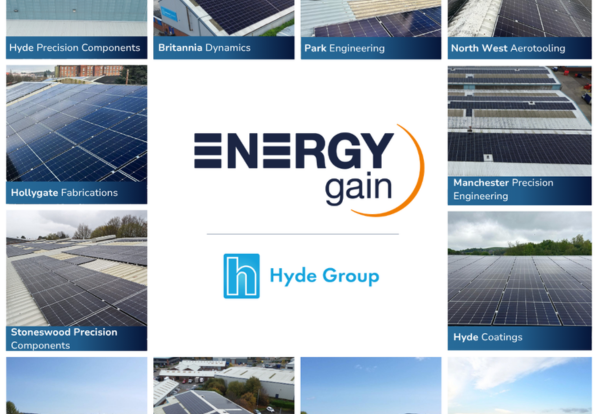
Within the aerospace sector, we have worked with Hyde Group and Haynes International. These projects have given us practical experience of working around complex manufacturing operations and understanding the importance of keeping energy projects aligned with the requirements of the business.
For an aerospace manufacturer, installing solar is ultimately an investment decision as much as an engineering decision. The system needs to work technically, but it also needs to make sense financially and fit within the longer-term plans of the organisation.
That is why we believe the best starting point is a proper assessment of the site’s energy use, rather than starting with a particular solar technology.
To find out more, contact Energy Gain UK at info@energygain.co.uk or visit: https://energygain.co.uk/