
Why video helps industry, manufacturing and aerospace communicate clearly
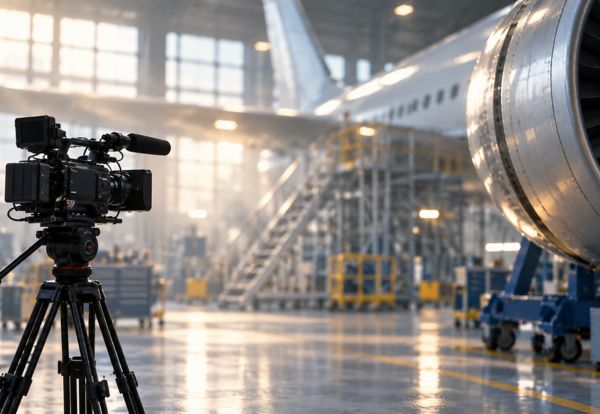
From complex engineering and manufacturing processes to training, recruitment and customer stories, Bigtank turns important information into films and animation that people can understand, remember and act on.
Some businesses can explain what they do in a sentence. In industry, manufacturing and aerospace, it is rarely that simple.
A product may be the result of years of engineering. A process might involve specialist knowledge, strict quality controls and several teams. The real value may sit inside a machine, material or system that most people will never see operating up close.
The audience is rarely one group, either. Engineers need accuracy. Procurement teams want evidence. Customers need to understand the commercial benefit. Employees need clear instructions. Potential recruits want to see the culture behind the machinery.
That is the communication challenge Bigtank helps to solve.
Since 2005, we have worked with organisations to turn technical, detailed and sometimes difficult-to-film subjects into clear, human content. We combine strategy, filming, interviews, animation, graphics and editing, choosing the right approach for the message rather than forcing every brief into the same format.
Start with the purpose, not the camera
Good video does not begin with a shot list. It begins with a useful question: what does this content need to achieve?
It may need to help a sales team explain a technical advantage, give customers confidence in a supplier, support a product launch, train colleagues consistently across several sites or show skilled people why a business is worth joining.
Once the purpose, audience and desired response are clear, the creative decisions become much more focused.
A two-minute overview might introduce a business on social media or at an exhibition. A detailed customer case study can build trust during a longer sales process. A library of short training films may solve an operational problem across different teams and locations.
One well-planned production can also generate much more than one film: a main video, shorter edits, interview clips, social content and stills for use across different channels.
In specialist sectors, accuracy matters just as much as presentation. The aim is not simply to make something polished. It is to make something useful.
Show the real work, and the people behind it
Industrial environments already contain strong visual stories: scale, movement, precision, materials, testing and the transformation of one thing into another.
Filming on the factory floor, in a research centre, at a depot or out on the road gives an audience evidence that a written claim alone cannot provide.
But capability is only part of the picture.
People make technical businesses credible. An engineer explaining why a detail matters, an operator demonstrating a process or a customer describing the difference a solution has made can build a level of trust that scripted claims often struggle to match.
Our role is to help contributors feel comfortable, ask the right questions and shape the resulting material without taking the life out of it.
That approach has informed more than a decade of work with Mercedes-Benz Trucks.
Across vehicles including the Econic, eEconic, Actros and Arocs, our films have taken us to sites, depots and roads, bringing together the engineering, the purpose of the vehicles and the people who depend on them.
The market has changed significantly during that time, particularly with the move towards more sustainable transport, but the importance of clear communication, consistency and trust has remained.
The goal is not to make engineering sound simple. It is to make it clear, without losing the detail that gives it value.
Make the invisible visible
Not every important feature can be captured by a camera.
A component may sit inside a larger assembly. A safety system may only reveal its value in circumstances that are impractical or unsafe to recreate. A new facility may still be under construction. Sometimes an audience needs to see a flow, comparison or internal movement that cannot be shown through conventional filming.
Animation, 3D visualisation and motion graphics can make those stories visible.
They can isolate a component, reveal an internal process, demonstrate an installation sequence or place a product in a realistic operating environment. Used alongside live footage, graphics can add context while keeping the film grounded in the real business.
Our work with advanced-materials specialist Tenmat is a good example.
Detailed 3D environments were used to explain wear parts, bearings and passive fire protection in rail and construction scenarios that would have been difficult to film. Accurate product replicas allowed individual components and their benefits to be highlighted clearly, helping customers understand the value behind the finished product.
Video can support the whole business
Video is often described as a marketing tool, but its usefulness reaches much further.
In manufacturing, engineering and aerospace, the same production approach can support sales, recruitment, learning and development, internal communication, customer service, exhibitions and leadership messages.
A customer case study can turn an existing relationship into credible evidence.
For warehouse technology business Körber, we captured a customer story at BES explaining how improved stock management supported greater warehouse efficiency and shorter order turnaround.
Recruitment films can help potential employees understand the people, environment and expectations behind a role, as in our work with manufacturer VEKA.
Training films can deliver a clear and repeatable explanation across different shifts, locations and teams, while animation can reduce ambiguity around technical or safety procedures.
The strongest approach is usually joined-up.
Rather than treating every requirement as an isolated film, organisations can build a useful bank of content around recurring audiences and communication needs. It creates consistency, makes better use of access to busy sites and specialists, and gives marketing and communications teams more flexibility throughout the year.
Experience across advanced manufacturing and aerospace
Complex organisations need production partners who can listen carefully, understand unfamiliar subjects and work responsibly in live operational environments.
Recent Bigtank projects show how that approach translates across research, advanced manufacturing and aerospace.
For the University of Sheffield Advanced Manufacturing Research Centre, we created a series designed to help small and medium-sized businesses understand that technologies such as robotics, artificial intelligence and smart energy are not reserved for the largest organisations.
The challenge was to preserve the substance of the research while making its practical relevance easier to understand.
Our work in aerospace has also included films for Brookhouse Aerospace and Olsen Actuators and Drives, helping communicate their capabilities, expertise and work around the Farnborough International Airshow.
Brookhouse’s company film was designed to tell the story of the business, its capabilities and the people behind it in a way that could work across its wider communications.
Bigtank is also a member of the North West Aerospace Alliance, helping us stay close to the sector, understand its priorities and build relationships across the regional supply chain.
That relationship led to Farnborough Focus, a 17-minute film developed with the Alliance for members preparing for the 2026 Farnborough International Airshow, together with shorter edits for use across other channels.
It is a useful example of how long-form and short-form content can work together. One creates depth, while the other helps the right audience discover it.
You can see more of our work with the sector on Bigtank’s aerospace and engineering video production page.
Clarity creates confidence
The best technical communication respects both the subject and the audience.
It does not remove complexity for the sake of a catchy line. It creates a clear path through that complexity, deciding what people need to know first, what evidence will help them believe it and what they should be able to do next.
For industry, manufacturing and aerospace businesses, that clarity has practical value.
It can shorten the distance between interest and understanding. It can help a buyer explain a decision internally, give employees a consistent message, attract people with the right expectations and make conversations at exhibitions more productive.
Bigtank brings strategy, storytelling and production together to make that happen.
We can scale from a focused single-camera interview to multi-location filming, drone work, live streaming and detailed 3D animation, drawing on a core team and trusted specialists.
What stays constant is the care taken to understand the organisation before asking an audience to understand it.
Because in complex sectors, the job is not simply to show more.
It is to show what matters.
About Bigtank
Bigtank Video Productions is based in Ramsbottom, Lancashire. We create authentic, story-driven films, animation and supporting content for organisations that need to explain, train, recruit, promote and engage.
Our work spans corporate film, customer case studies, recruitment, training, social content, drone filming, podcasts, live streaming, motion graphics and 3D animation.