Complete confidence in complex machining with Vericut
For precision subcontract machinist WES Engineering Solutions, confidence is fundamental to every machining operation. Manufacturing complex components for demanding industries that include aerospace, defence, nuclear and oil & gas demands absolute faith in every CNC program before the first chip is cut. By integrating Vericut simulation, verification and analysis software into its programming workflow, the Redruth-based company is verifying all four- and five-axis CNC programs before they reach the machine, safeguarding expensive equipment while enabling productive unattended machining.
WES Engineering Solutions employs around 40 people across three specialist divisions. Alongside its subcontract machining business, the company operates a hard metal engineering division specialising in grinding and EDM, together with British Classic Car Performance Braking, which manufactures high-performance brake calipers for classic vehicles. Everything from Austin, Daimler, Ford, Hillman and Jaguar, to Jensen, Land Rover, MG, Morgan, Sunbeam and Triumph.
Cross-division precision
Across its business divisions, WES machines materials that extend from plastics and copper to stainless steel, titanium and Inconel, machining complex, high-precision components to tolerances as tight as 10 μm, even lower in the case of hard-metal parts undergoing grinding or EDM.
Supporting these demands is an ongoing investment programme in advanced manufacturing technology. Since 2022, WES has boosted its subcontract offer by installing a trio of palletised Matsuura CNC machining centres. An H.Plus-300 four-axis horizontal model with 15 pallets was the first to arrive, followed by two five-axis vertical models, namely an MX-520 with four pallets in 2024 and an MX-330 with 10 pallets in 2026. The extensive pallet capacity provided by these high-performance machines allows the company to maximise lights-out production while increasing flexibility and throughput.
“We found the first Matsuura machine held tolerances exceptionally well, so when we needed additional five-axis capacity it made sense to invest in Matsuura again,” explains James Humphrey, Production Engineer at WES Engineering Solutions. “The latest MX-330 further increases our unattended machining capability, which is becoming increasingly important as customer demand continues to grow.”
Licence to mill
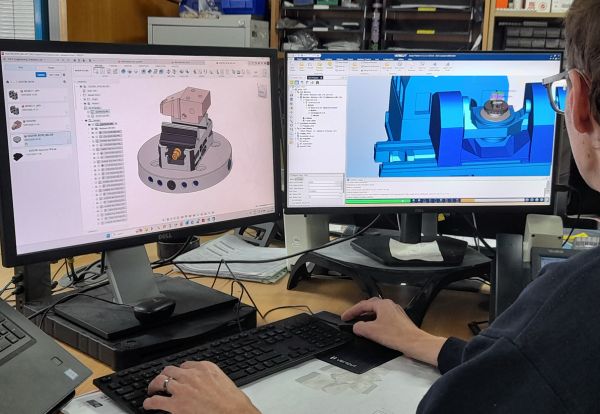
Alongside investment in machine tools came investment in Vericut simulation, verification and analysis software. WES currently has one Vericut licence, supporting its Matsuura machining centres. Using Autodesk Fusion 360 CAM software, programmers generate the machining strategy before transferring the job directly into Vericut via its integrated Fusion interface.
“When a new job arrives, we decide on the tooling, fixturing and most appropriate machine before creating the tool paths in Fusion,” explains James. “Moving the project into Vericut is incredibly straightforward – just a couple of clicks.”
Using Vericut’s Verification, Multi-Axis and Machine Simulation modules, WES simulates every machining process against digital models of its Matsuura machining centres, checking for collisions, over-travel and other potential issues before releasing programs to production. Vericut’s Auto-Diff module provides an additional layer of confidence by comparing the machined component with the original CAD model, highlighting any remaining stock or potential gouges.
“Vericut gives us complete confidence that the machine isn’t going to do something different to what we’ve programmed,” states James. “We’ve had occasions where the job looked fine in the CAM graphics, but Vericut highlighted something different. It prompted me to go back into Fusion, make a few changes, repost the code and check it again before sending it to the machine.”
Trust, then cut
For WES Engineering Solutions, independent verification is invaluable. The company regularly manufactures high-value components using equally expensive cutters and machines. Even a minor programming error can result in broken tooling, scrapped workpieces or even machine damage.
“We’ve all heard the stories of programming mistakes causing expensive collisions,” he notes. “Repairing or replacing a spindle on a five-axis machining centre wouldn’t be cheap. Every programmer, however experienced, worries about making that one tiny mistake. Vericut goes a long way towards mitigating that concern.”
The software also transforms and expedites the proving-out process on the shop floor. Rather than operators cautiously monitoring every program with a finger poised over the feed-hold button, they can approach new jobs with considerably more confidence.
“It saves time. What’s more, operators can confidently get on with other work instead of standing there waiting to see whether something goes wrong.”
Unmanned, unworried
This confidence becomes even more valuable when programming changes are made late in the working day before machines continue running unattended overnight.
“Confidence is everything,” reasserts James. “With Vericut, if I make a programming change at the end of the shift, I know I can ask the team to run it overnight without worrying about collisions.”
Before selecting Vericut, WES evaluated several alternatives. Alongside the software’s proven capability, access to UK-based technical support proved an important consideration. Following a trial period that included deliberately introducing programming errors, the decision quickly became clear.
“We wanted reassurance that the software would correctly identify problems before they reach the machine,” he remarks. “During the trial, Vericut detected everything we expected it to. Since then, the ongoing support has been very responsive whenever we’ve needed assistance.”
Value-added investment
Although the financial return is difficult to quantify precisely, James believes the investment continues to deliver value every day by preventing problems before they occur:
“The nature of Vericut means you never really know what it’s saved because the incidents simply don’t happen. It could be a broken cutter, a scrapped component or avoiding serious machine damage. In my opinion, more important is the complete peace of mind it provides, allowing us to concentrate on producing high-quality parts and meeting the delivery expectations of customers.”
Quality is everything at WES, which is why software like Vericut is so important to its operations. The company is committed to continuous improvement, investment in systems and automation, long-term capability development, and supporting customers in regulated and safety-critical industries.
WES Engineering Solutions carries accreditations for ISO 9001 and the AS9100 quality management system standard for the aerospace industry. In addition, the company holds Fit For Nuclear (F4N), a nationally recognised programme that assesses a company’s capability to operate within the UK nuclear supply chain, and JOSCAR registration, the collaborative accreditation system used by major aerospace, defence and security organisations. WES also complies with Cyber Essentials Plus, a government-backed certification that verifies the effectiveness of cybersecurity controls through independent technical testing.
Confidence in tomorrow
As WES Engineering Solutions continues expanding into increasingly complex, higher-value manufacturing sectors, confidence remains central to its future growth. With its investment in advanced machine tools and automated production, Vericut provides the assurance that every program has been thoroughly simulated and verified before manufacturing begins. The result? Safe, efficient and reliable machining for the benefit of both WES and its customers.
To learn more about Vericut® please visit: vericut.com/en-gb
To learn more about Wes Engineering Solutions please visit: WESltd.com